Monday, 28 November 2011

Post 8: Production Report

In our production we chose our location to be the abandoned deputy head office. The reason why we chose this location over the original Kings Meeting Room was because the Kings Room was occupied during the time of filming. This meant that we had to find another similar area that wouldn’t be affected by poor lighting, poor sound and poor safety. Luckily we found this in an abandoned office that also happened to agree with our mise-en-scene, only after a little time searching, meaning that we didn't loose very much production time.

We filmed our scenes during period 3, 4 &5 which were good because it meant that all the other students in the school were in lessons and therefore weren’t making noise and interrupting our sound.

For our scenes we finished up with a total of about 8 minutes of footage in which we used about 7 different camera shots. One of the shots we used was a long establishing shot. The reason why we used this shot is because we wanted to get the audience introduced to the environment and the characters. It also gave us a good way to get the audience eased into the narrative. Another camera shot we used was a medium close up. The reason why we chose to use a medium close up is so that we were easily able to capture what a character was feeling with his facial expression and body language. One problem we had when we were shooting this particular shot was that we had difficulties fitting the actors into the frame how we wanted them. This was quite tedious because it meant that we had to retake a few shots. We had to retake some of these shots because if we didn’t we would have had to use the poor quality shots we originally took, therefore making it look very unprofessional.

Thursday, 10 November 2011

Post 7: Additional Pre-Production Documentation

Before we start filming there is alot more work that we must do inorder to make sure that our production is sucessful and safe.

Risk Assessment:


Location Recce:

Post 4: Script Writing

 All films need a script, from documentaries to science fiction. A script helps us to understand the order of our narrative, the actors movements and what's happening in frame. It will be very useful to us because it will give us some guidelines for our piece.

This is our script.


Script Annotations:
Hugo: For the opening of our piece we will shoot both sides of the door in order to get the best sound and match on action. This is so that our piece flows a lot smoother and isn't jumpy.

Connor: For the over the shoulder shot reverse shot we will have to keep the camera in the same place on either side. This is in order to keep to not only the rule of continuity but also the 180° rule. This is so that its not too jerky for the viewer.

John:  We used a  low camera angle on our second shot of Harrison, it showed him as a character with status although during the interview it is the interviewer Ron Gilbert is the one with the power where he asks personal an pressuring questions.

Monday, 31 October 2011

Post 6: Shot List and Storyboard

 Storyboards and shot lists are very similar to a script but they're very useful because they give a more detailed and visual guide than the information that the script gives us.

Shot List:
Story Board:


Monday, 17 October 2011

Post 5: Jump Cuts, Over-The-Shoulder Shots, Cutaways and Point Of View Shots

These are some of the terms that I will be hearing alot of that's why I need to know them for when i'm making and editing my piece.

Jump Cuts: A jump cut is a transition between two shots which appears to "jump" due to the way the shots are framed in relation to each other. Jump cuts are usually caused by framing which is quite similar.


Example of a jump cut.


Over-The-Shoulder Shot:
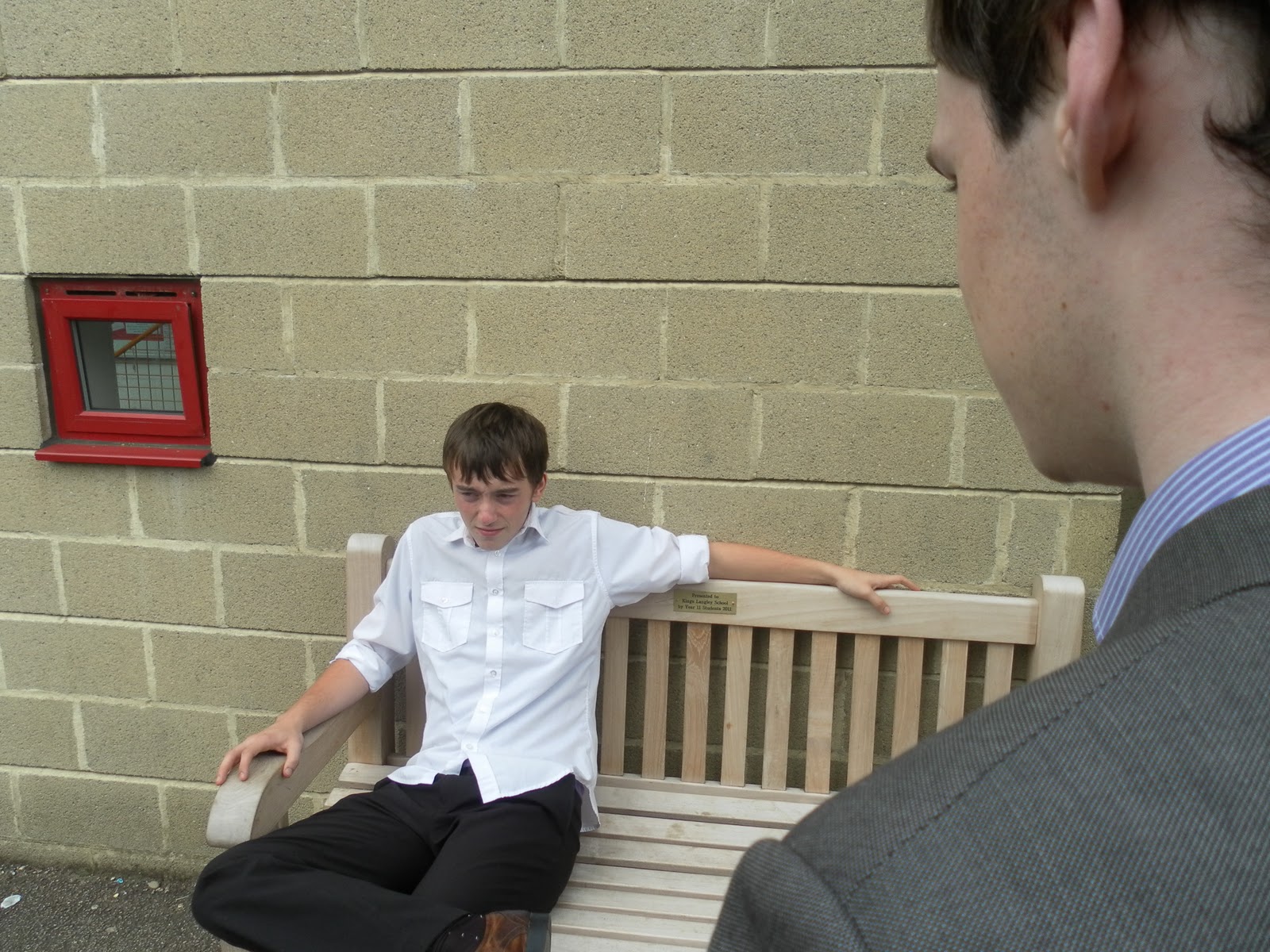
In film or video, an over the shoulder shot (also over shoulder, OS, OTS, or third-person shot) is a shot of someone or something taken from the perspective or camera angle from the shoulder of another person. The back of the shoulder and head of this person is used to frame the image of whatever (or whomever) the camera is pointing toward. This type of shot is very common when two characters are having a discussion and will usually follow an establishing shot which helps the audience place the characters in their setting. It is an example of a camera angle.
http://en.wikipedia.org/wiki/Over_the_shoulder_shot
Emaple of an over the shoulder shot


Point of View (POV):
A point of view shot (also known as POV shot or a subjective camera) is a short film scene that shows what a character (the subject) is looking at (represented through the camera). It is usually established by being positioned between a shot of a character looking at something, and a shot showing the character's reaction (see shot reverse shot). The technique of POV is one of the foundations of film editing.
http://en.wikipedia.org/wiki/Point_of_view_shot

Example of a POV shot.


A small video made by us demonstrating all of the different shots mentioned.
Video Link

Thursday, 22 September 2011

Post 3: Continuity

 In this post i will go into the details of continuity, in particular the 180 degrees rule and the effects of breaking convention. This will help me understand what rules i have to abide by when im making my piece.

What is continuity?
In fiction, continuity (also called time-scheme) is consistency of the characteristics of persons, plot, objects, places and events seen by the reader or viewer over some period of time. It is of relevance to several media.
Continuity is particularly a concern in the production of film and television due to the difficulty of rectifying an error in continuity after shooting has wrapped up.
http://en.wikipedia.org/wiki/Continuity_(fiction)

Continuity is where plot and visual consistency stay in order. For example,
In the left picture we can see that Frodo's scar changes from one side of his face to the other, where as in the right picture we can see that the characters t-shirt changes colour between shots. The reason why its important to keep continuity is because it can confuse the viewer and also break the suspension of disbelief, meaning that the audience becomes detached from the film and possibly loses interest.
One shot that we have to pay special attention to in terms of continuity is the match on action shot. We need to pay special attention to this shot because if we don't it is very easy for the shot to fail by breaking continuity.


The 180° Rule:
In film making, the 180° rule is a basic guideline that states that two characters (or other elements) in the same scene should always have the same left/right relationship to each other. If the camera passes over the imaginary axis connecting the two subjects, it is called crossing the line. The new shot, from the opposite side, is known as a reverse angle.
http://en.wikipedia.org/wiki/180_degree_rule


http://en.wikipedia.org/wiki/180_degree_rule
 The 180° rule is an important guideline to stick to whilst filming because if you don't it would disorientate the viewer and potentially put them off.
We especially need to stick by this rule when filming shot reverse shots, during dialogue.

Monday, 19 September 2011

Post 2: Storyboard Drawing, Shot Sizes and Framing. Continued

 Long Shot: This shot used for showing not only a character in his full stature built also for showing his surroundings. For example if the director wants an emphasis on the mise-en-scene in a certain shot he may choose to use this camera angle.
Medium Long Shot: This shot is used to show the character in his full profile whilst also allowing for some space to see the mise-en-scene.
3/4 Shot: This shot is used for showing the characters body and could also be used to show an emphasis on a characters body language.
Medium Shot: This shot is used in a similar way to the 3/4 shot but with more of an emphasis on the characters face.
Medium Close Up: This shot is used for when the director wants a deeper emphasis on the actors face and also what he is saying.
Close Up: This shot is similar to the medium close up but shows more of an emphasis on the characters face.
Extreme Close Up: This shot is used for showing emotion on a characters face, although it could also be used to show the importance of a certain object.

Establishing Shot: This shot is used to introduce a new location that is of significance, for example a director may choose to use this shot when he is showing the audience where a character lives.